Heaven
The Screwtape LettersHeaven is the eternal world of the Enemy in The Screwtape Letters, but the book makes it vivid chiefly through the distortions and involuntary admissions of its demonic narrator. Against Hell’s vision of existence as competition and absorption, Heaven is a realm where distinct beings are united without being erased, where pleasure is a natural good rather than a weakness, and where the patient at last recognizes the presence that had accompanied him through life. Its decisive significance lies in this reversal: the reality Hell calls impossible is experienced by the human soul as home.
Nature and Relation to Time
Heaven belongs to eternity, in contrast to the temporal world inhabited by human bodies, passions, and imaginations. Screwtape’s account of human life distinguishes the spirit’s orientation toward an eternal object from the body’s continual change. That change produces emotional and physical peaks and troughs, but it does not determine the soul’s final direction. The Enemy, as Screwtape calls God, seeks not merely a moment of religious feeling but enduring fidelity freely chosen within the changing conditions of earthly life.
This distinction shapes the letters’ treatment of the present. Humans live in time, yet are destined for eternity; the present moment is where time touches eternity and where a person can act with freedom and actuality. Attention to the eternal means attention to God, while attention to the present means responding to conscience, bearing the present cross, receiving grace, and giving thanks for pleasure as it comes. Heaven is therefore not simply a remote destination in the letters’ account. Its eternal reality gives the present moral and spiritual weight, even while the future can distract humans into fear, ambition, or unreal expectation.
Screwtape’s theology of spiritual dryness also depends on Heaven’s difference from coercive power. The Enemy may initially grant a convert a felt sense of presence, emotional sweetness, and apparent ease in resisting temptation, but does not maintain these supports indefinitely. In the trough, the human must carry out duties after their emotional reward has disappeared. Screwtape recognizes that the will’s continued intention to obey when God seems absent is especially dangerous to Hell: the human is being formed for a freely maintained relation, not compelled into submission by an irresistible spectacle. Heaven’s order thus cannot be reduced to the immediate comfort of religious feeling.
A Counterworld to Hell
The contrast between Heaven and Hell is expressed through opposed accounts of what it means to exist. In Screwtape’s description, Hell treats each self as closed against every other: one being’s gain must be another’s loss, and existence is competition. Its ideal is absorption, with the weaker will and freedom drawn into the stronger. Screwtape’s own image is of beings becoming food for the power that consumes them.
Heaven’s alternative is unity without absorption. Screwtape grudgingly describes the Enemy’s aim as a multitude of beings united to God while remaining distinct. Human freedom is not a residue to be conquered but part of what this relation preserves: the will is to conform freely, not to be swallowed. This is why the demonic logic repeatedly fails to explain divine love. Screwtape insists that one self cannot truly will another’s good, yet his own account of the Enemy’s design keeps exposing a radically different possibility: the good can be shared without one person ceasing to be oneself.
The same opposition appears in the letters’ treatment of ordinary life. Screwtape admits that the Enemy has filled the world with pleasures—sleeping, washing, eating, drinking, making love, playing, praying, and working—and that these things must be twisted before they can serve Hell. He particularly resents the patient’s entry into the family and social circle of the Christian woman he loves. In the family’s house and garden, even the gardener, dog, cat, and visiting guests seem to carry an influence he cannot penetrate. Hell assumes that each member must be exploiting the others, but cannot discover the hidden mechanism; the possibility that affection is not disguised self-interest affronts its first principles.
This ordinary domestic world is linked to Heaven by an image of life as music and silence. The house seems to Screwtape to resemble a human description of Heaven as a region where there is only life, so that everything other than music is silence. His recoil makes the contrast audible: Hell’s space and time, he boasts, are filled with Noise, which he calls the defense against scruples, despair, and impossible desires. His fantasy is to shout down Heaven’s melodies and silences across the universe. The boast is also a confession of vulnerability: noise must occupy every space because the quiet reality it seeks to drown out cannot be assimilated to Hell’s terms.
Heaven in the Patient’s Death
The letters’ culminating disclosure comes when the patient dies in a bombing and enters the new life. The transition is instantaneous: the bombs, collapsing houses, bodily exhaustion, and terror that filled his final earthly moment are gone. Screwtape bitterly notes that there has been no prolonged illness, nursing home, operation, or false hope of recovery. The ending overturns his expectation that suffering and fear have secured the soul for Hell; the apparent passage through a narrowing crisis opens instead into liberation.
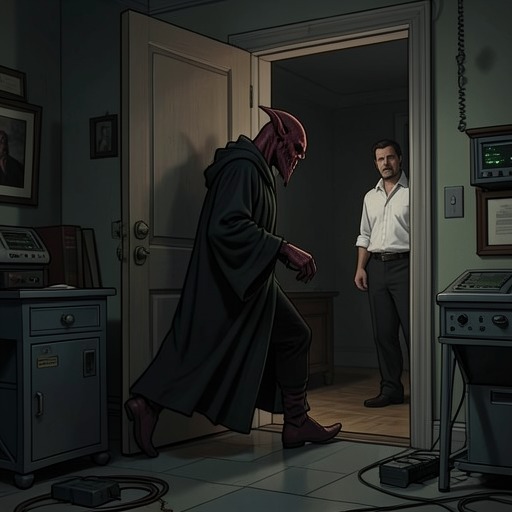
The patient’s arrival also reveals a presence he had not consciously understood during life. When he sees the spiritual beings gathered there, he does not encounter them as utterly unknown. He recognizes them, one by one, with the realization that they had been present at moments when he thought himself alone. The vague sense of friends surrounding him in childhood solitude is explained, and the central music that had accompanied his purest experiences but eluded memory is recovered. Recognition makes him part of their company almost immediately, while Screwtape alone remains outside.
More decisive still, the patient sees God. The contrast is bodily and immediate: the presence that is blinding and suffocating fire to Screwtape is cool light and clarity to the human. The patient’s prostration, self-abhorrence, and knowledge of his sins do not signify demonic paralysis. Pain may remain, but it is embraced rather than treated as a reason to reject the presence. Even the pleasures of sense, affection, intellect, and virtue that could once have tempted him are diminished beside the joy of finding the beloved who had seemed lost but is alive and present.
Narrative Function and Limits of the Demonic Account
Heaven is never presented as a neutral landscape surveyed from outside. Its reality reaches the reader through Screwtape’s letters, whose descriptions are shaped by fear, rivalry, and a persistent refusal to accept the meaning of what they disclose. Before the ending, Heaven is glimpsed indirectly in the Enemy’s eternal purpose, in the non-possessive love Screwtape cannot explain, and in the music and silence that disturb his kingdom of noise. At the end, the patient’s recognition gives these earlier hints a concrete narrative fulfillment.
Screwtape’s testimony must nevertheless be read with caution. The book’s prefatory warning is that the devil is a liar and that even his statements about matters within his own perspective should not automatically be trusted; his account may contain wishful thinking. That warning makes his admissions more, not less, revealing when his claims about Heaven conflict with his own evidence. He can describe the patient’s recognition, freedom, and joy, but his competitive assumptions leave him unable to interpret them except as an inexplicable threat to infernal power.
The ending therefore establishes Heaven less by supplying a map than by showing a change in the meaning of reality. What seemed alien to the patient becomes what he recognizes as having been present all along; what Hell calls weakness, pain, or foolishness cannot dislodge his welcome. Heaven is the destination of the patient’s earthly history, but it also reorders that history: its companionship and music disclose the hidden coherence of experiences that had once seemed solitary or only partly remembered.